I Let AI Score My Selfies — Here's What It Caught
Published July 18, 2026 • 7 min read
By PhotoExpert.ai Editorial Team • Last updated: July 18, 2026
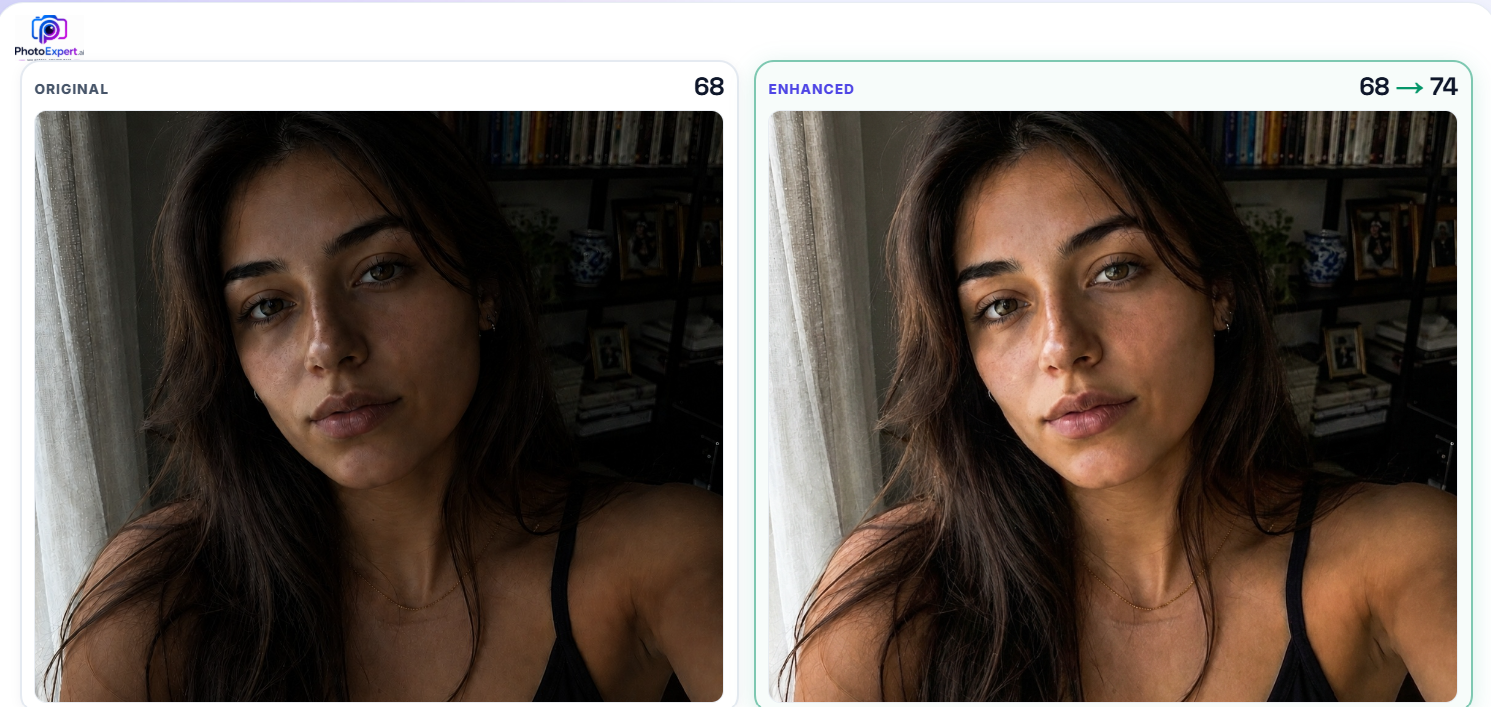
I have somewhere around three hundred photos of myself on my phone. I use maybe four of them, on rotation, across every app that asks for a profile picture. I've never really questioned why those four — they were just the ones that felt fine at the time, and “fine” was good enough to stop looking.
So when I decided to actually run a few of my go-to selfies through an AI photo scorer, I expected a shrug of a result. Maybe a compliment, maybe nothing useful. What I didn't expect was for it to catch things I'd been looking straight past for years.
The first one wasn't what I thought it was
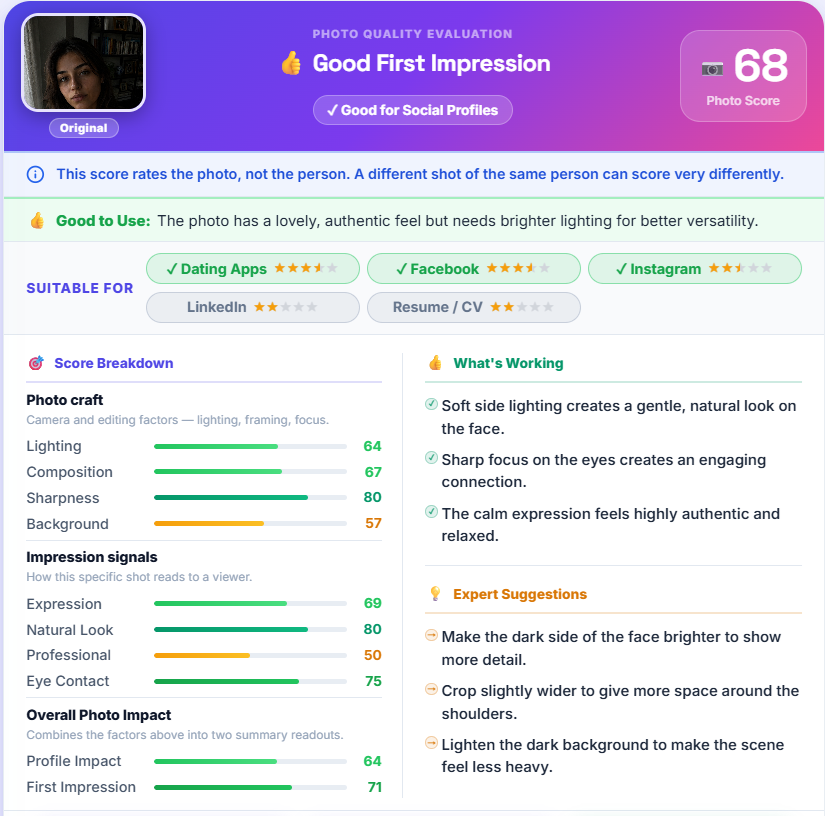
I picked what I'd have called my “safe” selfie — decent lighting, normal expression, nothing embarrassing. It came back with a fair score, not a bad one, and a note that the lighting was uneven across one side of my face. I went back and looked. It was right. I'd genuinely never noticed the shadow before, because I wasn't looking for it — I was looking at the whole photo, at “do I look normal,” not at any one specific thing wrong with it. That's the part that got me: it wasn't finding a flaw I'd missed because I was careless. It was finding one I couldn't have found, because I don't look at my own photos the way a tool built to look at nothing else does.
It's not grading you. It's grading the shot.
This is the part worth being upfront about, because it's easy to misread a number attached to your own face as a verdict on you. It isn't. Everything the tool actually measures — lighting, composition, sharpness, what's happening in the background — is a property of the photo, not a property of the person in it. A different photo of the same face, taken twenty minutes later in different light, can score completely differently. I proved this to myself by accident: two selfies from the same afternoon, same outfit, same expression, twelve points apart. The only thing that changed was where I was standing relative to a window.
What actually moved the number
None of what it flagged was really about how I look. It was about decisions I'd made without thinking of them as decisions — standing with a window behind me instead of in front, cropping too loose so the background did half the work in the frame, taking the photo at the one moment my expression looked mid-sentence instead of settled. Little, boring, completely fixable things. The kind of thing a professional photographer would catch instantly and I never would, because I'm not looking at myself as a subject — I'm just checking whether the photo is embarrassing, which is a much lower bar than “is this actually a good photo.”
The same photo, judged for different jobs
The part that surprised me most wasn't the score itself — it was seeing the same photo rated differently depending on what it was being judged for. One of my selfies scored well for casual social use and considerably worse as a professional photo, for reasons that had nothing to do with how I looked and everything to do with framing and setting. It's obvious once you see it laid out, but I'd never actually thought about my own photos that way before. I had one photo I used everywhere, on the assumption that a decent photo is a decent photo. It isn't. Context changes what “good” even means.

Fixing it without fixing me
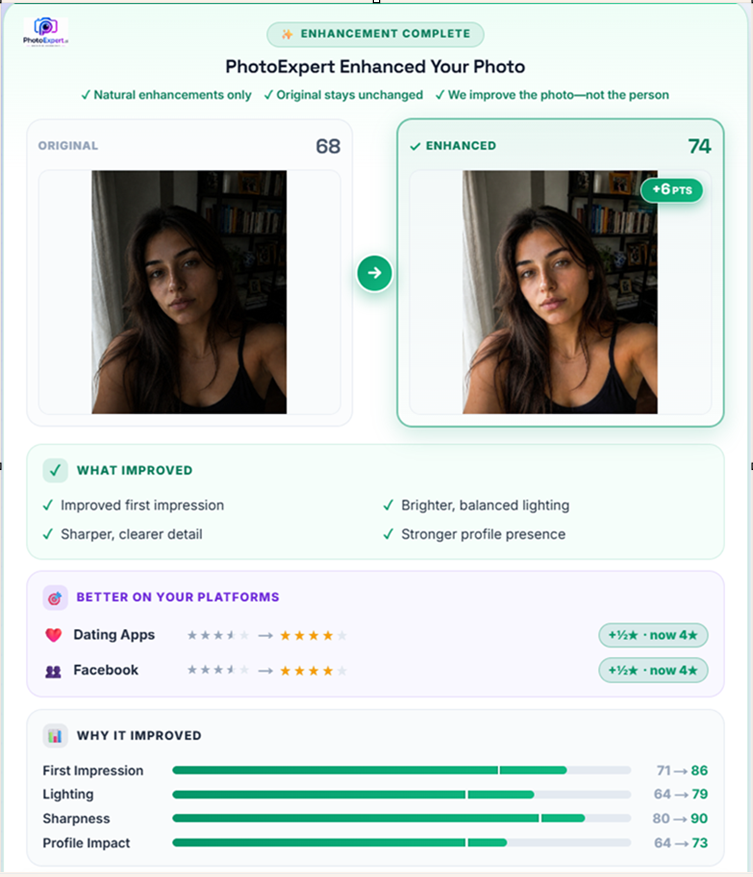
The part I was genuinely skeptical of going in was the enhancement step — I've used enough photo apps that promise a “better you” and deliver something that doesn't look like you at all. This wasn't that. The corrected version brightened the shadowed side of my face, balanced the color a little, and that was it. Same face, same photo, just — clearer. Nothing about my actual features changed, which is honestly the bar I was expecting it to fail, and it didn't.
What I actually took from this
I went in expecting either nothing useful or something a little uncomfortable, and got neither. What I got was closer to having someone who actually knows what they're looking at glance at my photo and tell me, plainly, what wasn't working — not “you,” the photo. That's a strange thing to feel relieved by, but I did. I'd spent years assuming my “fine” photos were just fine, because I'd never had a reason to look closer, and it turns out looking closer wasn't the uncomfortable experience I expected it to be.
Curious what your go-to selfie is actually doing?
Run one photo through PhotoExpert.ai's Review & Enhance and see what the score catches — light, crop, timing, and context — before you attach it to another profile.
Review & Enhance your photo →If you've got a photo you've used everywhere for years without really questioning it, run it through Review & Enhance and see what it actually catches. It might not be what you think.